Cody and Isaac (on the right) behind the Curtain at Wonderfalls, Big Sandy River, WV
IR and the boating community lost a great friend late Tuesday (8/26) evening. Isaac and 2 others were paddling on the rain swollen Road Prong in the Great Smokey Mountains when Isaac was swept downstream into a flooded West Prong. Despite valiant efforts of the paddlers that were with him, they were unable to rescue him.
Isaac was a great friend of IR as he had been hanging around the Confluence/Ohiopyle area since his highschool days. Over the years, he has become a big part of the paddling community at large, recently moving to the Great Smokies to work and play down there. He was a charismatic, affable and unique person, and his presence will be missed anywhere that he touched down. He was 26.
His family asks that any gifts be made in the form of donations to either American Whitewater or the Bethel Presbyterian Church.
American Whitewater PO Box 1540
Cullowhee, NC 28723
Please put “In Memory of Isaac Ludwig” in the memo field of the check or the comment field online. All funds will be used for river stewardship efforts.
A memorial service will be held Tuesday, September 2, 2008 at 6:30 PM at the Bethel Presbyterian Church, 16521 Steubenville-Pike Rd, Salineville, OH 43945
Do you have the same water-reading ability as this slalom racer?
The Yough Valley paddling season came to a buzzing crescendo this past weekend as literally thousands of spectators and hundreds of racers descended on Ohiopyle for the annual “Over the Falls Festival”, an event structured around the impressive but relatively safe Ohiopyle Falls. Ostensibly, the focus of the event is a sprint race over the falls, but really the draw for most is the chance to run the otherwise illegal falls in the daylight without having to worry about being chased through poison ivy and rhododendron by park rangers. Regardless of the paddler’s motivations, the event is a really fun time, and Barry Adams and the rest of the crew from American Whitewater do a great job of not only putting on the festival, but in a very clear way point out the absurdity of keeping the falls off-limits to kayakers for the rest of the year. Details on the event (and even more interesting, the dialogue between AW and the Bureau of State Parks) can be found here, and be sure to watch Dave Fuselli’s video (below this post) to see great footage of the falls race.
Following the Falls Race on late Saturday afternoon was the annual “Upstream World Championships”, a race down and back up Entrance Rapid- a class III rapid at the start of the lower Yough. While this race has a distinctively more low-key presence than the Falls event (only 19 people entered the Upstream race), for many of the local paddlers and guides this is the THE competitive event of the season. With race times ranging anywhere between 8 and 25 minutes, a mass start, and no boat or gender classes, I have to admit that to the uninitiated, the race can look a little whimsical, but I can assure you that many very serious and competitive paddlers have repeatedly called this the most difficult race they have ever done. To win the race requires either world-class paddling speed, a hyper-tuned knowledge of every rock and current in the rapid, an inhuman ability to process lactic buildup in your forearms, or all of the above. It is one race where every serious participant pushes their body to the edge of complete failure in order to finish.
Meanwhile, 11 miles upstream of the excitement and crowds surrounding the Falls festival, the annual Riversport slalom was quietly underway on Ramcat rapid, organized by Natalie Thomas and her crew. With none of the glamor of the Falls event, or bravado and street cred of the Upstream race, the Riversport Slalom nonetheless has a pedigree- and I would argue a value- that neither of the two Ohiopyle events can touch. For starters, old-school paddlers like myself and wife, who came-of-age in kayaking in the early 80’s, recognize that events like this race, and the dozens of others that used to be spread up and down the east coast (T-Ville, Tohickan, the Esopus, Loyalsock, Deerfield, Ocoee Double Header, and the NOC Spring Race just to name a few) aren’t just obscure footnotes in paddling history, but actually part of paddling’s DNA. Back then, it was generally understood that running rivers and the technical challenges of running gates were the same thing, and out of that era came a class of American paddlers whose depth of skills and water knowledge is almost unheard of nowadays.
Also consider the fact that slalom races like this one can not only challenge competent paddlers but also embrace newcomers of almost all skills. On one hand, I would say that 1 in 60 falls race competitors could achieve a clean run on the Ramcat slalom course, but at the same time, my father-in-law raced open canoe with my 3 year old son. Dana Chladek -who medaled in both the 92 and 96 Olympics- was there coaching her group of kids from DC, ages 11-18 as well as her “master’s league”- a group of more mature paddlers honing their skills and fitness levels.
The discussion of the re-birth of slalom in the US and the constant chatter about how to “grow paddlesports” in our industry is so played that I am not going to even start to prostelytize on either subject. I will say that when I go to run big whitewater, and a newcomer in the group comes from slalom background, I am almost sure that he or she will be the best paddler of the day. I will also point out that my son won a rubber ducky this weekend for his race with his grandad, and he can’t wait until the next one.
Some photos, and thanks to Jess Steinour for the pics of upstream race:
This Saturday was the 10th Annual American Whitewater Ohiopyle Falls Race in Ohiopyle Pennsylvania. Ohiopyle is my stomping grounds I think the first time I paddling the Yough river I was ten years old. This is a fun event for me because not only can I run a waterfall and do some competing but my father was able to run the falls and watch me compete. This year there were roughly 200 people from Pennsylvania, Ohio, Virginia, Maryland, New Jersey and beyond in attendance for this years race and brutal freestyle event. The race involves a few class three rapids leading up to a 18 foot waterfall fastest times being around a minute. After the Race however there is a freestyle event which I ended up 2nd in this year. Falls Race is the only time when private boaters can legally tackle the Class III rapids and 18 foot waterfall because of the state park regulations. This is an obstacle that all of us kayakers are hoping to change. Here is a video from the event.
If you were near Avon Co this summer from the 15th of June to the 15th of Aug you had the opportunity to make $2,500 doing a little kayaking in Avon new playpark. The town put up the money and what you had to do was make a video of yourself in the playpark and the biggest air won. This was a way to get people into the park. If you check out the video you can see the town of Avon did a pretty good job making a sweet feature that will give up some pretty big air. Check this video of Demshitz takin the money!
…are now starting to come in. I’m not going to go in to details about what the IR VTH is- if you don’t know, you can get the full story here. In the meantime, we have begun preparing the video entries for the web, and here is the first one that we have ready. Ladies and Gentlemen, I take great pleasure in introducing “Team Low Pressure”:
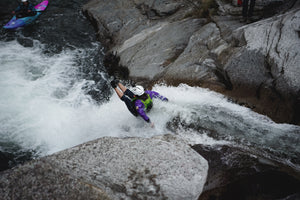
A few weeks ago, long-time IR supporter and athlete Jed Selby sent me pictures of his recent trip to California, and I happened to notice that in one of the shots, he appears to be running a rather large waterfall backwards. I wrote him back, and he verified that he indeed ran the drop stern-first, and sent me the full photo sequence. He also sent me the post he made on his South Main kayak team blog. Here is an excerpt, detailing what happened. The full photo set is at the bottom.
From Jed’s blog post:
When running a 50-foot waterfall, it’s usually the on-water portion of the adventure that I’m most concerned about. But sitting in my boat, wedged precariously between two rocks, it was the eight-foot “seal launch” directly above the lip of the 50 footer that had me most concerned. Ideally I would have a calm pool above the drop in which to prepare. But in this case just getting into my boat without prematurely sliding down the rock and off the waterfall was a challenge. Once I was safely in my boat, I pushed as hard as I could to lift myself and my 90-pound boat up and onto the narrow rock that I would be sliding down. I pivoted 90 degrees and let my bow hang over the edge. I was perfectly positioned to slide down 8 feet of granite and then directly off 50-foot Dead Bear Falls.
The waterfall had a cave on the right side of the landing so my intended line was to aim slightly left and straighten out on the lip, avoiding said cave. I ran the scenario through my head several times, planning how I would push off, the stroke I would take at the lip and then the forward tuck to minimize the impact of the landing. Once all the steps were clear in my mind, I pushed off.
I rocketed down the granite ramp and hit the water at the lip only to find that it was slightly shallower than it looked. I could feel the rock shelf at the lip catch the nose of my boat, and in the next moment I felt the full weight of my stern, loaded with my overnight camping gear, pull like a heat-seeker for the pool 50 feet below. Before I knew it, I was looking over my shoulder and spotting my landing as my boat lined up perfectly backwards and the freefall commenced.
My back broke the tension of the water and completely softened the landing as I entered the pool below. I went deep and surfaced backwards and upright, clear of the recirculating hole at the base of the falls and the pothole on river right. I couldn’t have run it better if I’d planned it—backwards that is.